
AEC-Q101: Analysis of the "Gold Safety Standard" for Automotive-grade TVS Devices
A、What is AEC-Q101?
AEC-Q101 is a reliability certification standard for automotive-grade discrete semiconductor devices formulated by the Automotive Electronics Council (AEC). It is specifically applicable to discrete components such as diodes, transistors, MOSFETs, SiC/GaN power devices, TVS, and ESD protection devices, and is a mandatory entry threshold for entering the global automotive electronics supply chain.
It should be particularly emphasized that AEC-Q101 does not define the electrical parameters or performance indicators of the device, but focuses on long-term reliability. The core objective is to ensure that the device achieves "zero failure" operation performance throughout the entire life cycle of the vehicle (typically designed for 15 years or 240,000 kilometers) under harsh conditions such as extreme temperatures (-40℃ to +175℃), high humidity, vibration, and electrical stress.
In recent years, with the accelerated application of domestic automotive-grade chips in vehicles, an increasing number of domestic enterprises have begun to lay out the construction of AEC-Q101 certification capabilities. For instance, Shanghai Leiditech Electronic has fully introduced automotive-grade certification processes in its TVS and ESD product lines to support the demand for high-robustness circuit protection in new energy vehicles.
B、Why is AEC-Q101 important for hardware design?
- Industry requirements: Global Tier1 suppliers (such as Bosch, Continental) and mainstream OEMs (such as Tesla, Toyota, BYD) all clearly require that all discrete semiconductors used in the original equipment market must pass the AEC-Q101 certification, and uncertified devices cannot be included in the BOM list.
- Reliability Assurance: The design philosophy of automotive-grade components is different to consumer electronics - it does not require "the strongest performance", but must be "absolutely reliable". The AEC-Q101 has passed dozens of tests in five major categories, systematically verifying the device's survivability in real vehicle environments.
- Shorten the development cycle and reduce rectification costs: By using the part numbers that have passed AEC-Q101, the failure investigation time during the EMC environmental test stage can be significantly reduced. Actual measurements show that the “one go” success rate of ADAS modules using compliant automotive-grade protection devices has significantly increased when passing the ISO 10605 electrostatic test in third-party laboratories.
- Engineer Knowledge Co-construction: In the engineer community, the EMC team from Leiditech helps designers gain a deeper understanding of the collaborative relationship between AEC-Q101 and EMC design through case analysis, standard interpretation, and other methods, thereby enhancing the robustness of the vehicle's electronic system.
C、Analysis of the Main Test Dimensions of AEC-Q101

Automotive-grade components are not about being more user-friendly, but about being error-free. AEC-Q101 is to ensure that components operate stably under extreme conditions throughout the entire life cycle of a vehicle.
D、Three typical applications: How automotive-grade TVS "Quietly guards"

Application 1: CAN/CAN FD Bus - The "Highway" of Vehicle Communication
Challenge: Static electricity (±30kV) and power fluctuations can easily cause damage to transceivers.
Solution: Leiditech applies AEC-Q101-certified low residual voltage TSS (such as LMP2570SDQ), precisely matching the working voltage to 12V/24V systems, with a response time of less than 1ns. Designed specifically for in-vehicle CAN electrostatic surge protection, it can not only prevent surges and static electricity, but also ensure signal integrity. 
High-speed interface optimization: For the CAN FD high-speed interface, Shanghai Leiditech Electronic applies the integrated ESD array SMC24LVQ for electrostatic protection, with a capacitance of less than 5PF, to avoid signal edge distortion. It can ensure signal integrity while passing the electrostatic test.
The EMC team from Leiditech reminds: 90% of on-site communication failures result from the omission of interface protection devices - no matter how powerful the MCU is, it cannot withstand the direct impact of surges.
Application 2:BMS (Battery Management System) - The "Safety Valve" of High-voltage Platforms
Challenge: Under an 800V platform, the transient voltage of the load can reach over 202V, far exceeding the conventional DC-DC withstand voltage!

-
- Solution: The SM8S series TVS of Leiditech Electronic (such as SM8S33CA) has passed the AEC-Q101 certification, meeting the requirements of ISO 7637-2 5a/5b and ISO 16750-2, with an operating temperature range of -55℃ to +175℃.
- Key point: TVS is not an "optional" option but a mandatory protection level for the BMS input end.
✅ Application 3: ADAS Cameras and Sensors - The "Invisible Shield" for High-Speed Signals - Solution: The SM8S series TVS of Leiditech Electronic (such as SM8S33CA) has passed the AEC-Q101 certification, meeting the requirements of ISO 7637-2 5a/5b and ISO 16750-2, with an operating temperature range of -55℃ to +175℃.

-
- Challenge: High-speed links such as LVDS and USB 3.0 are extremely sensitive to parasitic capacitance - an additional 0.1pF may cause the eye diagram to close.
- Solution: Leiditech’s ultra-low capacitance automotive-grade ESD array (such as ULC0524PQ), with a capacitance of only 0.4pF (IO-IO), response time <0.5ns, and certified by AEC-Q101.
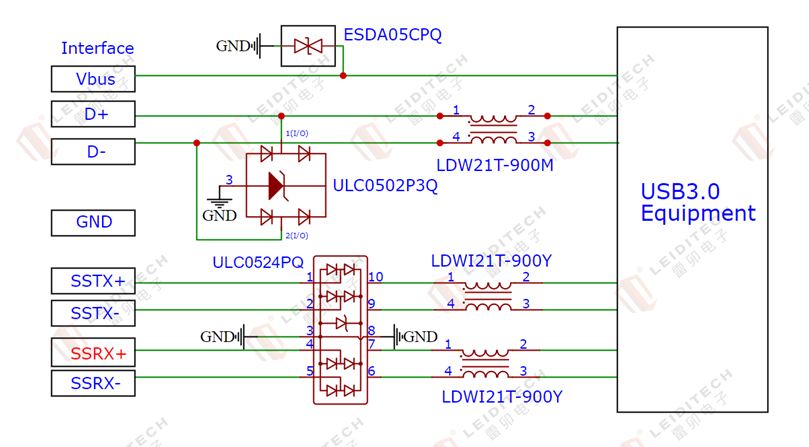
- Challenge: High-speed links such as LVDS and USB 3.0 are extremely sensitive to parasitic capacitance - an additional 0.1pF may cause the eye diagram to close.
Actual test results: The ADAS module with automotive-grade ESD/TVS recommended by Leiditech passed the electrostatic test in one go in a third-party EMC laboratory, significantly shortening the development cycle.
E、Conclusion: From "usable" to "daring to use", AEC-Q101 is the cornerstone of trust
For hardware engineers, choosing a TVS or ESD device is not merely a matter of parameter matching, but also a transfer of responsibility for system reliability. AEC-Q101 offers an industry-proven reliability baseline, allowing designers to "rely on it with confidence".
As a leading provider of circuit protection solutions in China, Shanghai Leiditech Electronic has been deeply engaged in automotive electronics for many years. Currently, Leiditech 's AEC-Q101 product line has been widely applied in: new energy three-electricity systems (BMS, OBC, DC-DC), intelligent cockpit (USB, HDMI, Type-C), autonomous driving domain controller (CAN/CAN FD, Ethernet, sensor interface). The Leiditech technical team provides one-stop support from selection, testing to rectification
