
Leiditech Empowers Energy Storage Safety: Building a Full-chain Protection System
一、Leiditech Empowers energy storage safety - Expert in Anti-static Surge protection
Today, with the explosive growth of the new energy industry, the safety of energy storage systems has become a core issue in the industry. As the "heart" of energy storage systems, battery management systems (BMS) are confronted with multiple challenges such as surge impacts, static interference, and communication stability. As a professional supplier of protection solutions and components, Leimao builds a triple security barrier for BMS with its professional technology:
- Power protection: High-power TVS diodes are adopted to achieve millisecond-level response to surge impacts, ensuring stable power supply for the BMS. Even in scenarios of grid fluctuations or lightning strikes, the system can maintain continuous operation.
Signal protection: ESD electrostatic protection devices provide anti-static capabilities for signal buses such as CAN and RS485, meeting the strict standards of ±15kV for contact discharge and ±25kV for air discharge, ensuring zero-distortion transmission of communication signals.
- Full-chain EMC solution: Leimao provides full-scenario protection covering power supply, signals, and interfaces, helping customers pass international certifications such as ISO 10605-2 and achieve dual breakthroughs in safety and energy efficiency.
Lei MAO has an industry-leading team of EMC (Electromagnetic Compatibility) design and rectification experts. We are capable of providing EMC training,EMC rectification, free EMC testing, and EMC component selection and supply.
The successful experience of Lei MAO has helped the client rectify and pass the "GB/T37408-2019 Technical Specification for Grid-connected Inverters in Photovoltaic Power Generation".
二、Scenario-based solutions: Precisely adapting to diverse energy storage demands
In response to the differentiated demands of various application scenarios, Leiditech customizes and develops protection solutions to promote the implementation of energy storage technology.
In the field of new energy vehicles: Certified by ISO 10605-2 standard, the protection scheme can withstand extreme static electricity environments, adapt to the high-frequency communication and high reliability requirements of on-board BMS, and safeguard the safety of power batteries.
- Industrial and commercial energy storage scenarios: Adopting a low leakage current design (such as the SM8S series), the standby power consumption is reduced to the microampere level, meeting the low self-discharge requirements of long-term energy storage. It is particularly suitable for scenarios such as photovoltaic energy storage and backup power supplies for data centers.
Attached: Block diagram of the core interface protection scheme


三、Regulatory Map of the Energy Storage Industry: Comparison of Chinese and European Standards and Compliance Guidelines
The global layout of energy storage products needs to overcome complex regulatory thresholds. Lei MAO has compiled a comparison of Chinese and European regulations for core products to help enterprises quickly grasp the key points of compliance: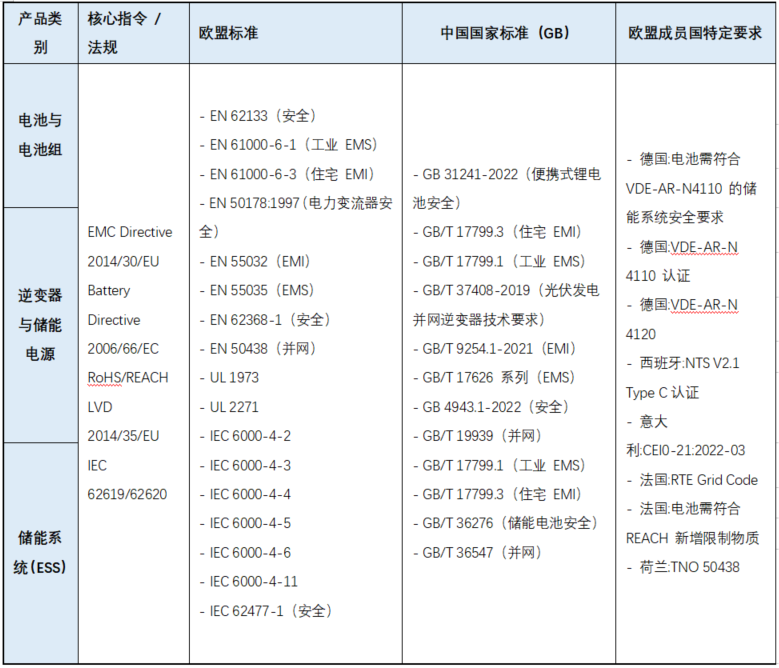
Analysis of Key Compliance Points
- EMC test: The EU EN 55032/55035 corresponds to China's GB/T 9254.1 (EMI) and GB/T 17626 series (EMS). Special attention should be paid to electromagnetic radiation and anti-interference ability.
- Grid connection requirements: EU EN 50438 is directly connected to Chinese GB/T 19939 (Photovoltaic) and GB/T 36547 (Energy Storage), involving technical details such as power quality and protection functions.
四、A Panoramic View of Battery Technology: A Showdown of Cost, Performance and Application Scenarios
The selection of energy storage technology routes requires a comprehensive consideration of multiple dimensions such as cost, lifespan, and safety. The following is a comparison of the mainstream battery types:
|
电池类型 |
铅酸电池 |
磷酸铁锂 |
钠电池 |
石墨烯铅酸 |
锰酸锂电池 |
三元锂电池 |
固态电池 |
传统 |
|
是否量产 |
是 |
是 |
否 |
是 |
是 |
是 |
否 |
是 |
|
单位成本(美元/kWh) |
约100~200 |
约100~200 |
约100~200 |
约120~220 |
约200-400 |
约300~500 |
500~1000 |
- |
|
循环次数(次) |
300-500 |
2000-3000 |
1500-2500 |
600-1000 |
500-2000 |
1000-2000 |
3000-5000 |
- |
|
日历寿命(年) |
2~3 |
5~10 |
5~10 |
3~5 |
3~5 |
5~10 |
10~20 |
10月15日 |
|
长期成本 |
长期成本高 |
单位成本较低,但使用寿命长,长期成本较低 |
较低,适合低成本应用,适用于电动工具和储能等领域 |
长期成本虽降低,仍偏高 |
市场份额小导致维护成本增加,整体仍偏高 |
适用于长程需求,整体成本略低于磷酸铁锂 |
单位成本非常高,但使用寿命非常长,长期成本最低 |
|
|
耐久年衰减率 |
15-20%/年 |
5-10%/年 |
3-5%/年 |
10-15%/年 |
8-15%/年 |
4-6%/年 |
1-2%/年 |
- |
|
能量密度 |
30-50 |
140-220 |
175-200 |
80-120 |
100-150 |
150-250 |
500+ |
8500-12000 |
|
高温影响 |
高温失水容量衰减加速,寿命缩短,可能引发电池内部分解反应 |
高温稳定性较好,安全性较高,可能引发电池内部分解反应 |
高温时相对较为稳定,会发生电解液蒸发等问题,导致容量下降 |
稳定性较好,但仍可能出现容量衰减和过热问题 |
高温时相对稳定,但高温会影响其寿命,可能导致材料老化和容量衰减 |
过高温度会导致热失控,增加安全隐患,且会加速电池衰减 |
高温稳定性较好,且在较高温度下不会出现液态电池的泄漏和热失控问题 |
发动机高温可能过热,但冷却系统可应对。 |
|
低温影响 |
低温电池内阻增大,容量大幅下降,启动困难,适用性差 |
低温性能较差,电池容量明显下降,放电效率降低 |
低温性能优良,适用于低温环境 |
在低温下稍好,会出现容量衰减和放电效率降低的问题 |
低温性能较差,容量明显下降,放电效率降低,要加热装置。 |
低温性能较好,适应性较强 |
低温性能极好,不容易出现容量下降和效率降低问题 |
启动困难,需预热改 |
|
使用温度范围 |
0-50℃ |
-20-75℃ |
-40-60℃ |
-10-50℃ |
-20-60℃ |
-10-60℃ |
-40-100℃ |
-40-60℃ |
|
BMS管理需求 |
简单,较少管理需求 |
较高,需控制电池温度和电量 |
高,精确管理充电放电和温度,且需适配新化学体系 |
中等,管理系统稍复杂 |
中等,需精确管理充电放电过程 |
高,需精确控制电池状态 |
极高,需精确控制电池状态 |
简单,较少管理需求 |
|
安全性 |
较差,可能发生酸泄漏或短路 |
非常安全,热稳定性强,耐高温 |
较为安全,使用时需避免过度放电
Leiditech recommended a schematic diagram of the electrostatic protection device for the RK3588 deve
EMC Design Pitfall Avoidance Guide: Four Don 'ts
Leave a ReplyYour email address will not be published.Required fields are marked. *
|