
After a 30% price increase, the survival rules for TI: Five "Counterintuitive" Truths About Interfac
In the late-night office, experienced hardware engineer Mr. Zhang was staring at the newly received supply chain email, with cigarette ash accumulating in the ashtray. The email's body was concise and to the point: Due to the strategic adjustment by Texas Instruments (TI), the prices of over 60,000 product part numbers across the board have increased, with an average increase of 10% to 30%. Some industrial and automotive-grade chips even exceeded 25%.
For Mr. Zhang, this is not merely a change in a cost figure; it is an imminent survival signal. In today's era of intense cost pressure, the seemingly insignificant electrostatic discharge (ESD) devices, when accumulated, are rapidly eroding the project's profit margin. How can we, in the context of the overall price adjustment across TI's product line, achieve a 30%-50% cost optimization through precise technical substitution while ensuring that the performance does not decline but improves? This is no longer a "choose-yourself" question; it is a "must-answer" question that determines the profit margin of the product. Today, I will combine Leiditech's practical experience to reveal five highly insightful "counter-intuitive" truths in interface protection.
Fact 1: The essence of substitution is not "exactly the same", but "a 5% tolerance of artistic variation"
When many junior engineers are looking for domestic alternatives, they tend to suffer from "perfectionist obsession", always wanting to find a part number that is exactly the same as the one with silk-screen printing. But in the eyes of senior engineers, P2P (pin to pin) alternatives are a kind of "art" that involves strictly aligning key parameters.
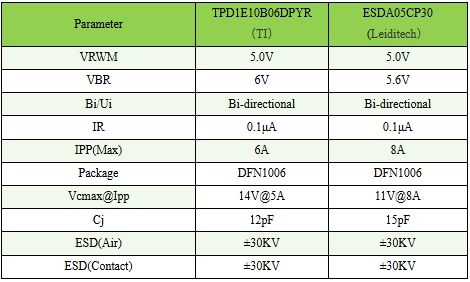
According to the core logic of the technical verification, the electrical characteristics of the substitute material must be highly compatible with those of the original part number, especially the following three key indicators: VRWM (reverse turn-off voltage), VBR (breakdown voltage), and Cj (junction capacitance).
"Parameter alignment: The errors of VRWM, VBR, and Cj with the original part number must be controlled within 5% to ensure that the circuit can be directly replaced without changing the PCB design. This is the technical baseline to guarantee the functionality of the circuit."
Take the classic single-channel ESD protection part number TPD1E10B06DPYR from TI as an example. In Leiditech's solution library, the corresponding ESDA05CP30 achieves a perfect mapping of electrical parameters. More importantly, we need to solve the "assembly anxiety" of hardware engineers: Leiditech's solution perfectly supports micro packaging such as DFN0603 and SOD523. This means that you can achieve seamless switching without modifying any wiring and pads.
Fact 2: Bandwidth is the "ceiling" of interface protection, while capacitance is its "restraint mechanism".
In high-speed signal design, the parasitic capacitance (Cj) of protective devices is the "number one enemy" for signal integrity. Many engineers habitually choose the part number with the strongest protection capabilities, but they overlook the negative correlation logic between transmission rate and capacitance. The higher the transmission rate, the stricter the requirements for capacitance. If the capacitance is too large, the signal waveform will undergo severe distortion, resulting in data packet loss.
Ø Extremely low threshold for high-speed protocols: For top-rate interfaces such as PCIe Gen 6+ or USB 3.2 Gen 2 (20Gbps), the parasitic capacitance must be strictly controlled to be less than 0.3pF.
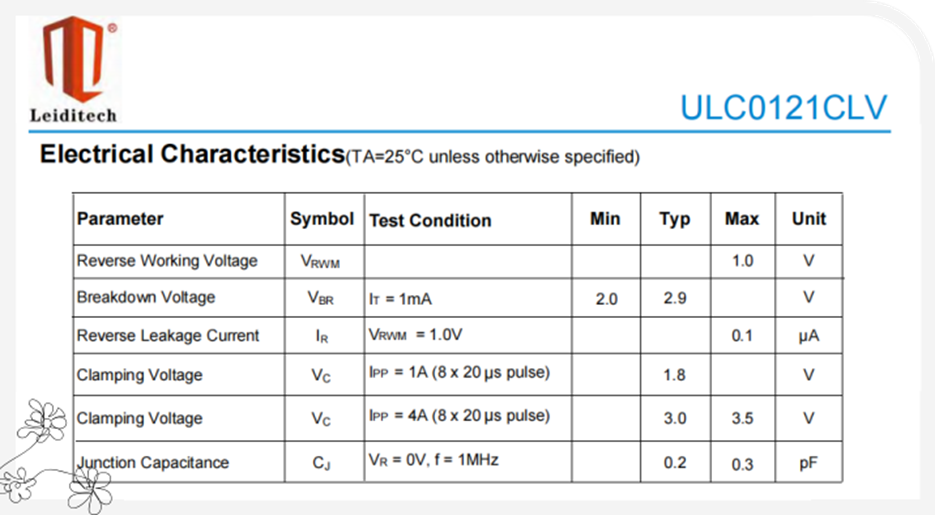
Ø Special requirements for antennas: This is a detail that is often overlooked - for RF antennas operating at frequencies up to 15GHz, it is necessary to use specialized components such as Shanghai Leiditech's ULC0121CLV, which have a capacitance of only 0.2pF (even less than 0.5pF).
Ø Reliability of low-speed protocols: In contrast, the CAN bus (< 1 Mbps) can tolerate < 30 pF, while the LIN bus (< 20 kbps) can even accept 50 pF.
This "bandwidth for space" technical logic tells us: At high-speed interfaces, every picofarad (pF) of compression is contributing to the survival of the system's signal bandwidth.
Fact 3: The power cord doesn't need to be "slim"; it needs "thick" and robust muscles.
This is a typical design flaw: believing that all interfaces only require ESD with low junction capacitance.
The truth is: The requirements for junction capacitance for power lines (such as the Vbus of USB Type-C) are extremely lenient, but the requirements for energy absorption capacity (Surge/Surge Protection) are extremely high. The Vbus pins do not transmit data and can tolerate up to 150pF of parasitic capacitance, but they must possess "thick muscles" to resist lightning strikes or switching transient shocks, that is, large IPP ESD or TVS.
We need to adopt different protection strategies based on the environment:
Ø Indoor short-distance (mainly for anti-static protection): Mainly for handling human touch, use conventional ordinary capacitive ESD components.
Ø Outdoor long-distance (must prevent surges): Components exposed outdoors such as Vbus, outdoor network ports or antennas are highly susceptible to induced surges. At this time, I recommend using the SD0501P4-3 to SD3002P4-3 series from Leiditech's DFN2020-3 packaging. In harsh outdoor environments, it is often necessary to use GDT (gas discharge tube) in combination with TVS/ESD for two-level protection, and through multi-level shunting strategies to ensure the absolute safety of the downstream IC.

Fact 4: Domestic alternatives are not merely "cheaper", but represent a significant performance upgrade through a "downgrading attack" approach.
Many people believe that domestic alternatives mean sacrificing performance for price. This is completely a cognitive bias. In the field of electrostatic protection, Leiditech's solution has already achieved a "performance superiority" over international giants in certain indicators.
The most crucial indicator is the clamping voltage (Vc). The lower the Vc, the smaller the residual voltage on the downstream IC during electrostatic discharge, and the more thorough the protection.
* Example comparison: The clamping voltage Vc of a certain part number from TI might be 12V, while the upgraded model ULC0342P from Leiditech has a Vc of only 5V.
Ø Anti-static redundancy: Some Part number such as ULC0511CDN have an anti-static performance that can reach ±30kV, far exceeding the industry standard of ±8kV.
In addition to performance, the advantages in the commercial dimension are also overwhelming:
Ø Cost: Generally lower by 30%-50% compared to the price increase of TI.
Ø Delivery time: The typical delivery time of TI is currently 3-5 weeks, while Leiditech, with the advantage of domestic spot availability, can shorten it to 1-2 weeks. In a market environment where "the fast fish eats the slow fish", delivery time is the lifeline.
Fact 5: It's not just the selection process; the PCB layout is the hidden "last 1 kilometer" that needs attention.
As an experienced technician who has spent 10 years in the laboratory, I must impart a secret tip to my new colleagues: Choosing the right part number is only half the battle; the rest depends entirely on the quality of the PCB.
Ø Prioritize integrated solutions: For multi-channel high-speed differential signals like HDMI or USB, it is strongly recommended to abandon discrete components and instead use the four-channel integrated solution provided by LMULC1545CLV. This not only reduces the number of components but also significantly reduces parasitic inductance through the symmetrical physical structure.
Ø Eliminate ground impedance: During layout, the GND pins of protective components must be connected to the ground plane through a large area of copper. Don't expect that a thin and long trace to be able to dissipate the instantaneous several thousand volts of energy. Remember, reducing ground impedance is the only shortcut to dissipating energy; otherwise, even the most expensive ESD components will become useless.
Conclusion: From "Passively Suffering from Price Increases" to "Actively Reconstructing"
TI's strategic adjustment towards high-profit markets such as automobiles and industries is creating a huge window of opportunity for the substitution of domestic standard components. For hardware engineers, instead of being anxious every time a price increase notice arrives, it is better to actively reconstruct their supply chain system.
By precisely aligning key parameters such as VRWM, VBR, and Cj, and using a lower clamp voltage to achieve performance superiority, we can turn the crisis into an opportunity. Finally, leave a question worth reflection by all R&D directors:
"Today, with supply chain security becoming a core competitiveness, how many 'highly premium' hidden dangers without technical barriers are still left on your circuit boards?"