
Electrostatic problems of electronic robots in the era of artificial intelligence and preventive mea

In the era of artificial intelligence, electronic robots are integrating into various fields such as industry, service, and medical care at an unprecedented speed. From precision operations in industrial production to auxiliary diagnostics in the medical field; From the efficient operation of logistics distribution to the intimate companionship of family services, electronic robots have greatly improved production efficiency and improved people's quality of life.
However, with the increasing application, the sensitivity of electronic robots to static electricity becomes more and more prominent in the process of use. This is mainly due to the increasing complexity of technologies, the need to adapt to diverse environments, and the dynamic operational requirements. So how can these problems be solved? Shanghai Leimo EMC small brother would like to share with you some circuit design how to do electrostatic protection.
一、Static electricity problems encountered by robots
l Damage to electronic components: Electrostatic discharge (ESD) may cause permanent damage to semiconductor components inside the electronic robot, such as integrated circuits, chips, etc. When the electrostatic voltage exceeds its withstand threshold, it will lead to the breakdown of the insulation layer inside the device, so that the electronic components can not work properly.
l Data errors: Static electricity may interfere with the electronic robot's storage unit, resulting in errors or loss of stored data. For example, during the operation of the robot, static electricity may change the program code in the flash memory, thus affecting the control logic and operation performance of the robot。
l System failure: Electrostatic discharge may cause the robot's control system to fail, resulting in abnormal robot action, communication interruption and other problems. For example, static electricity may interfere with a robot's sensor signal transmission, causing a bias in the robot's perception of its surroundings, which in turn affects its navigation and operation.
l Electromagnetic interference: The electromagnetic field generated by static electricity will interfere with the RF circuit and wireless communication module of the electronic robot, reduce the communication quality, and even lead to communication interruption. For example, in the process of wireless charging, static electricity may interfere with the transmission of charging signals, affecting the efficiency and stability of charging.
二、Electrostatic solution for circuit design
With the continuous development of electronic products, the precision of microcontrollers is increasing, which makes its protection requirements for external static electricity more and more high. Although in the manufacturing process, we can reduce the risk of static electricity by optimizing the environment, but this is only to reduce it, and in the use of products, we can not put forward harsh requirements for the environment, so the circuit design of more stringent electrostatic protection is particularly critical, the following are some circuit design methods that can effectively reduce the electrostatic problem of electronic robots:
1. Reasonable layout and wiring design
PCB layout is particularly important, for the electrostatic impact is obvious, this part of the content more details, here focus on summary.
Reasonable layout: The circuit that is easy to generate static electricity and sensitive to static electricity is arranged separately. For example, the power circuit, the drive circuit and other parts that are prone to interference are separated from the sensitive parts of the control circuit and the sensor circuit to reduce the impact of static interference.
Follow the layering principle: In the multi-layer circuit board design, the power layer and ground layer are placed next to each other, and the capacitance effect between the power layer and ground layer is used to provide a low impedance return path for static electricity and reduce the accumulation of static electricity on the circuit board.
Control cable distance: Ensure that there is sufficient distance between signal cables and power cables. Do not route signal cables parallel to high-voltage or high-current lines to reduce electrostatic interference on signal cables through electromagnetic coupling.
Shorten the cable: shorten the length of high-frequency signal lines and sensitive signal lines to reduce the chance of electrostatic coupling. For example, the microprocessor's clock signal line is designed to be as short as possible to reduce the risk of clock signal distortion caused by static interference.
2. Electrostatic release protection circuit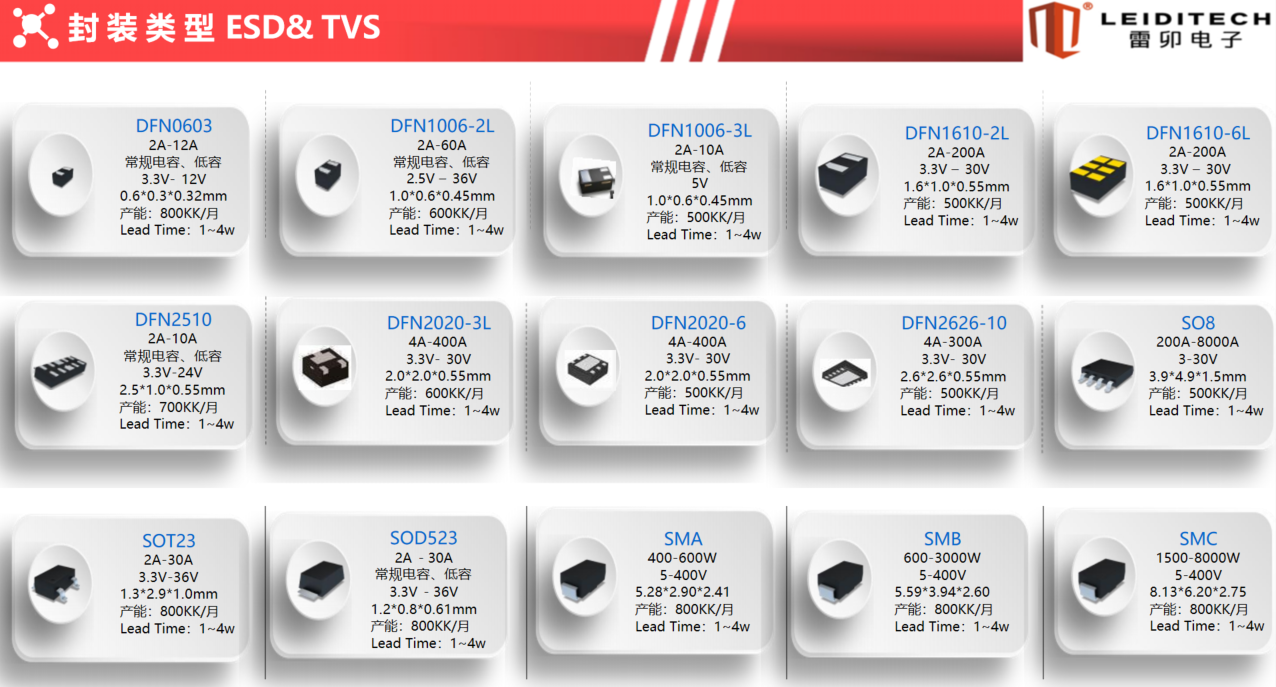
TVS Diode protection: Shunt transient voltage suppression diodes (TVS) on critical signal lines and power lines. ESD protection circuit (e.g. RC filter, clamp diode) is designed around the sensitive chip. When the transient high voltage caused by electrostatic discharge occurs, the TVS diode can respond quickly to clamp the voltage to a safe value, protecting other components in the circuit from high voltage damage. For example, the installation of TVS diodes on the communication interface line of the robot can effectively prevent the damage of static electricity to the communication chip.
3. Sensor and interface circuit design
Sensor electrostatic protection: Add an electrostatic protection circuit to the input and output ports of the sensor, such as TVS, to limit the voltage of the sensor port within a safe range to prevent electrostatic damage to the sensor. For sensors that are susceptible to static electricity, such as capacitive sensors, a shielding layer can be set around them and grounded to reduce the interference of external static electricity on the sensor.
Interface circuit optimization: In the external interface of the robot, such as USB interface, HDMI interface, etc., integrated special ESD protection devices. These devices can quickly respond to electrostatic discharge, discharge electrostatic energy, and protect the interface circuit and the connected internal circuit from electrostatic damage. Corresponding to the network interface and power interface, isolation transformer, photoelectric isolator, common mode filter, etc., are used to isolate obstacles to prevent external static electricity from entering the internal circuit of the robot through the interface.
The following figure is the UBS interface electrostatic protection scheme designed by Shanghai Leiditech. Among them, ESD protection components are used SD1501P4-3, ULC0502P3, ULC3304P19, and high frequency common mode filter LDWI21T-900Y.
"On Leiditech electronic" small program collects and organizes commonly used interface electrostatic protection schemes, including the robot commonly used, USB, RJ45, RS232/485, HDMI,WI-FI, I2C,SPI/UART, analog input interface, CAN interface, etc. You can search wechat for reference, or contact Shanghai Lei MAO EMC brother and sales staff.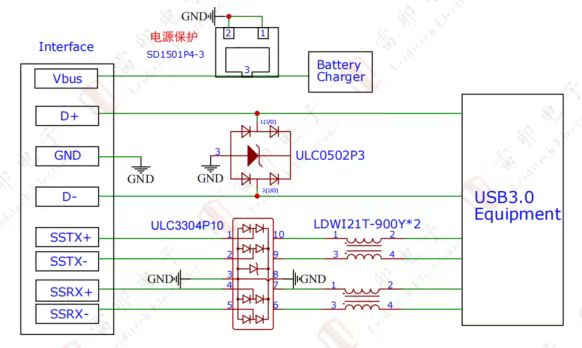
4. Filtering and decoupling design
Power filter circuit: Design LC filter circuit or PI filter circuit at the input end of the power supply, using the characteristics of inductance and capacitance, filter out high-frequency noise and electrostatic pulse in the power supply, and provide stable and pure power supply for each circuit module of the electronic robot. For example, a small inductor is connected in series on the DC power line, and then a large-capacity capacitor is connected in parallel to the ground to form an LC filter circuit, which can effectively suppress static interference on the power line.
Decoupling capacitor layout: Multiple decoupling capacitors with different capacity values are placed near the power pin of each chip, generally using a combination of 0.1μF and 10μF. The capacitor of 0.1μF is used to filter out high-frequency noise, and the capacitor of 10μF is used to deal with low-frequency interference and storage charge to ensure the stability of the chip power supply and prevent power fluctuations caused by static electricity from affecting the chip.
5. Grounding and shielding design
Single point grounding: The ground of each circuit module inside the robot is connected to a common ground point by using a single point grounding method. This can avoid the ground potential difference between different circuit modules and reduce the generation of electrostatic circulation.
Grounding line design: Ensure that the grounding line has sufficient width and low resistance to ensure that static electricity can be quickly and effectively imported into the ground. In general, the width of the grounding line should be reasonably designed according to the size of the current to minimize the grounding resistance.
Electromagnetic shield design: For circuit modules that are susceptible to static interference, such as radio frequency modules, audio modules, etc., metal shield is used to shield, and the shield is well grounded. The shield can block the interference of the external electrostatic field, but also prevent the static electricity generated by the internal circuit from radiating out, and improve the antistatic ability of the circuit.
Use of shielded lines: In the transmission of sensitive signals, use shielded lines. For example, the encoder signal line of the robot, the video line of the camera, etc., and the outer metal shielding layer of the shielded line are grounded, which can effectively reduce the interference of static electricity on signal transmission and ensure the integrity and accuracy of the signal.
Leiditech is committed to becoming a leading brand in the supply of electromagnetic compatibility solutions and components, supplying ESD, TVS, TSS, GDT, MOV, MOSFET, Zener, inductors and other products. Leiditech has an experienced R & D team, can provide personalized customized services according to customer needs, to provide customers with the best quality solutions.