
MOSFET (metal-oxide semiconductor field-effect transistor) is a key device commonly used in electronic circuits, especially in switching power supplies, motor drives and other fields. For beginners, there is a problem of not knowing how to identify G DS poles and circuit connection errors. To master the use of MOSFET skills, we must first start from the circuit diagram, a solid grasp of the basic knowledge of MOS tube, this step seems basic, but it is the key to the subsequent complex circuit design. It is hoped that the content of this paper can provide useful reference for beginners in circuit design.
one Classification of MOSFET
In practical applications, we most often use enhanced MOSFETs, including NMOS and PMOS. By contrast,
NMOS has a wider range of application scenarios and is used far more frequently than PMOS.
二.MOSFET uses basic techniques
1. Fast identification of NMOS and PMOS
Identify from the symbol: NMOS: the middle arrow points to the ditch, PMOS: the middle arrow points back to the ditch.
2. Fast recognition of GS pole
The MOS tube has three pins: source S (source), Gate G (Gate) and Drain (Drain).
The Gate (G) controls the on-off and on-off of the MOS tube.

In MOS symbol, the G pole is relatively easy to identify alone on one side, and the S pole and D are very difficult to identify. How to remember?
Refer to the figure above, S pole: it is not NMOS, or PMOS, the two lines and above intersect is the S pole;
D pole: not NMOS, or PMOS, a single wire lead is the D pole;
Below is the common actual product pin definition:

3. Fast identification of body diode direction
The direction of the body diode is consistent with the gate source diode arrow: for example, the NMOS gate source diode anode is connected to the S pole, and the body diode anode is also connected to the S pole. The PMOS gate source diode cathode is connected to the S pole, and the body diode cathode is also connected to the S pole.
In the future, even if we encounter the MOS symbol without a body diode, we can also imagine the direction of the body diode.
Like the picture below. The direction of the disintegrated diode will know the direction of the controlled current.
4. Quickly determine the direction of controlled current
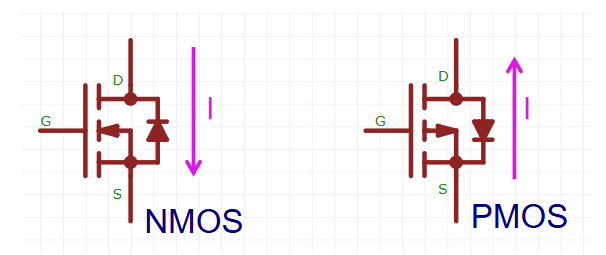
In the application of MOS tube, the current is unidirectional controllable, that is, the gate G is used to control the unidirectional flow of current. The flow of the controlled current is opposite to the direction of the body diode, and only in this way can it be controlled.
5. Control voltage of NMOS and PMOS
Macro view: NMOS is turned on when VGS > 0, and turned off when VGS ≤ 0;
PMOS is turned on when VGS < 0 and turned off when VGS ≥0.
The specific VGS is greater than the number of voltage open, pay attention to the specific MOS tube model parameters specification.
6. Application position and direction of NMOS and PMOS
NMOS generally do the lower tube, PMOS do the upper tube, easy to control. Connect the lower tube to GND, and connect the upper tube to VCC. The correct position of MOS tube is marked in the figure below.
MOS tube When we are connected in the circuit, the S pole and the D pole are easy to reverse, whether it is NMOS or PMOS, remember the position of the S pole is connected to the power side. That is, when the NMOS is used as the down tube, the S pole is connected to the GND on the power side, and the PMOS is used

On the tube, the S pole is connected to the VCC on the power side. You can also remember the two marked connections below.
7. Commonly used MOS tube package voltage and current internal resistance

MOS tube package, voltage, current, internal resistance, which is the main parameters of MOS tube. This is clearly stated on the first page of the specification. According to these parameters we can roughly determine whether it is suitable for use.
The above is Lei MAO EMC brother to share the use of MOSFET skills, perhaps you have a better way, welcome to share, learn together.
三.Shanghai Leiditech multiple package parameters MOSFET
There are a variety of packages, voltage, current, internal resistance NMOS and PMOS, which can be used for small signal control and can be used for high-power load drive. If necessary, please visit Shanghai Leimo official website or contact EMC brother and sales staff.

Leiditech is committed to becoming a leading brand in the supply of electromagnetic compatibility solutions and components, supplying ESD, TVS, TSS, GDT, MOV, MOSFET, Zener, inductors and other products. Leiditech has an experienced R & D team, can provide personalized customized services according to customer needs, to provide customers with the best quality solutions.